June 7, 2026
Nervous Before Anchoring? Do These 5 Things Before You Step On Stage
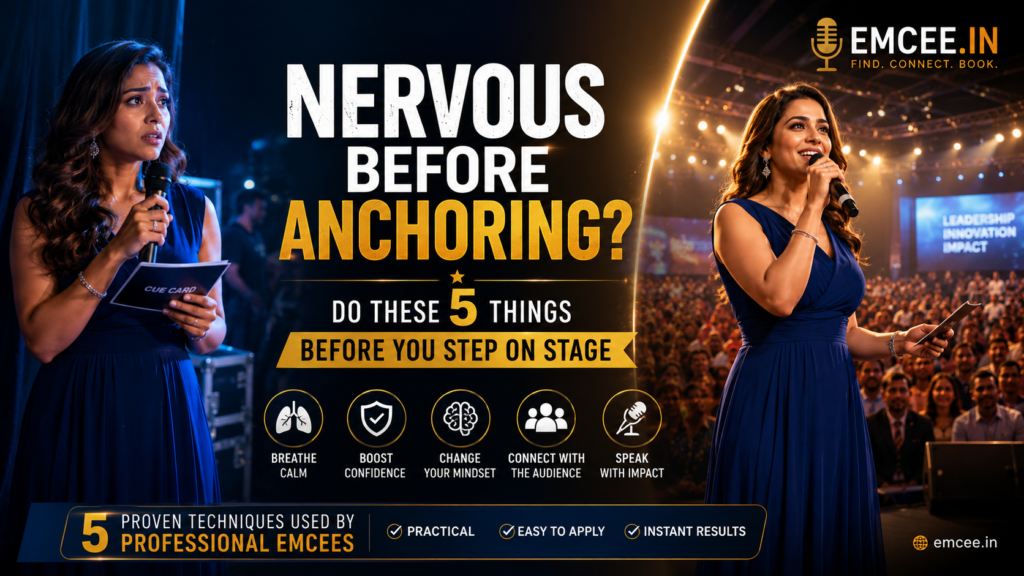
Professional emcees, television hosts and public speakers all feel nervous before a live event. Here’s how to turn pre-stage anxiety into confidence in under five minutes.
Why Every Anchor Gets Nervous Before Going On Stage
You are backstage.
The crowd is buzzing.
In five minutes they will call your name and your hands are already sweating.
If that sounds familiar, you’re not alone.
Every professional emcee, television presenter and public speaker experiences pre-stage nerves. The difference between an amateur and a professional is not the absence of anxiety—it is the ability to channel it into performance.
Before you walk onto the stage, try these five proven techniques used by experienced hosts across India.
Technique #1: Box Breathing — Override The Panic Response
Why It Happens
When nervousness kicks in, breathing becomes shallow. Your brain interprets this as danger, which increases your heart rate, tightens your throat, and makes your hands shake.
How To Do It
Find a quiet corner backstage and repeat this cycle four times:
- Breathe in slowly through your nose for 4 seconds
- Hold your breath for 4 seconds
- Exhale slowly through your mouth for 4 seconds
- Hold with empty lungs for 4 seconds
Why It Works
Controlled breathing activates the parasympathetic nervous system and reduces the fight-or-flight response. Your brain receives a signal that the environment is safe, helping lower physical symptoms of anxiety within minutes.
Technique #2: The Power Pose — Reset Your Body Language
Why It Matters
Your posture affects how you feel.
Standing hunched over your phone or script before going on stage can amplify feelings of anxiety and stress.
How To Do It
Two minutes before your introduction:
- Stand with your feet shoulder-width apart
- Open your chest
- Pull your shoulders back
- Place your hands on your hips
- Look slightly upward
- Hold this posture for 60 seconds
Why It Works
Open body language interrupts the closed-off posture associated with nervousness. It also creates a calming pre-performance ritual that helps you feel more in control.
Technique #3: The Heavy Feet Trick — Stop Shaky Knees
The Problem
Trembling legs are one of the most visible signs of stage fright.
How To Do It
When you reach center stage:
- Plant your feet shoulder-width apart
- Keep your knees slightly bent
- Press your heels firmly into the floor
- Imagine your shoes are weighted
- Hold the pressure for the first 30 seconds
Why It Works
Adrenaline creates excess physical energy. By deliberately engaging your leg muscles, you redirect that energy into stability and grounding.
The audience sees confidence. You feel control.
Technique #4: The Friendly Face Method — Manage Crowd Anxiety
The Problem
Looking at hundreds of people at once can feel overwhelming.
Your brain sees a crowd as a single intimidating entity.
How To Do It
Before the event begins, identify three people:
- One person on the left
- One person in the center
- One person on the right
These can be friends, teachers, colleagues, or simply approachable-looking audience members.
When you begin speaking:
- Deliver your opening sentence to the person on the left
- Speak your next thought to the person in the center
- Shift naturally to the person on the right
Why It Works
Instead of performing for 500 people, your brain feels like it’s having three simple conversations.
This instantly reduces pressure while improving eye contact and audience connection.
Technique #5: Reframe Nervousness As Excitement
The Secret
Anxiety and excitement feel almost identical physically.
Both create:
- A faster heartbeat
- Sweaty palms
- Increased adrenaline
- Heightened alertness
The difference lies in how you interpret those sensations.
What To Say
Instead of saying:
- “I’m nervous.”
- “I hope I don’t mess up.”
Say:
- “I’m excited.”
- “I’m ready.”
- “This energy will help me perform.”
Why It Works
Research suggests that reinterpreting nervous energy as excitement helps maintain performance energy while reducing feelings of threat and fear.
The goal is not to eliminate adrenaline.
The goal is to use it.
What To Do If You Blank On Stage
First, don’t panic.
Second, don’t apologize.
Most audiences never notice small mistakes.
If you lose your train of thought:
- Pause for a second
- Smile
- Take a breath
- Glance at your cue card
- Continue confidently
A brief pause appears intentional to the audience.
Only you know it wasn’t part of the plan.
Professional emcees don’t avoid mistakes.
They recover from them quickly and gracefully.
Final Thoughts
Every successful emcee, television host, keynote speaker, and stage presenter has felt nervous before walking on stage.
The secret is understanding that nervousness is not a weakness.
It’s evidence that you care.
Use these five techniques before your next event, and you’ll discover that confidence isn’t something you wait for—it’s something you create.
The microphone doesn’t belong to the most fearless person in the room.
It belongs to the person who steps up despite the fear.
Frequently Asked Questions
Is stage fright normal for professional anchors?
Yes. Most professional anchors, television hosts, and public speakers experience some level of pre-performance nervousness regardless of their experience level. The objective is not to eliminate it but to manage it effectively.
How long before an event should I do box breathing?
Ideally, begin box breathing 5–10 minutes before you are scheduled to go on stage. Four complete cycles usually take just over a minute and can be repeated if needed.
What if I forget my lines while anchoring?
Pause, smile, check your cue card, and continue. Avoid apologizing or drawing attention to the mistake. Most audiences never notice brief pauses.
Does saying “I’m excited” really work?
Research on cognitive reappraisal suggests that reframing anxiety as excitement can improve performance because both emotions share similar physiological responses.
How do I stop my voice from shaking?
Focus on deep breathing before speaking, take a full breath before your opening line, and speak slightly slower than feels natural. A controlled pace helps stabilize your voice.
Can I hire a professional emcee if I am not confident enough to anchor myself?
Absolutely. Professional emcees are available for corporate events, school functions, college festivals, weddings, award ceremonies, product launches, and entertainment shows across India.
Looking For A Professional Emcee?
Browse verified event anchors, wedding hosts, corporate emcees, and stage presenters across India on Emcee.in.
Find. Connect. Book.