June 24, 2026
Thinking on Your Feet: How Great EMCEEs Speak Confidently Without a Script – The EMCEE Academy™ | Article 10
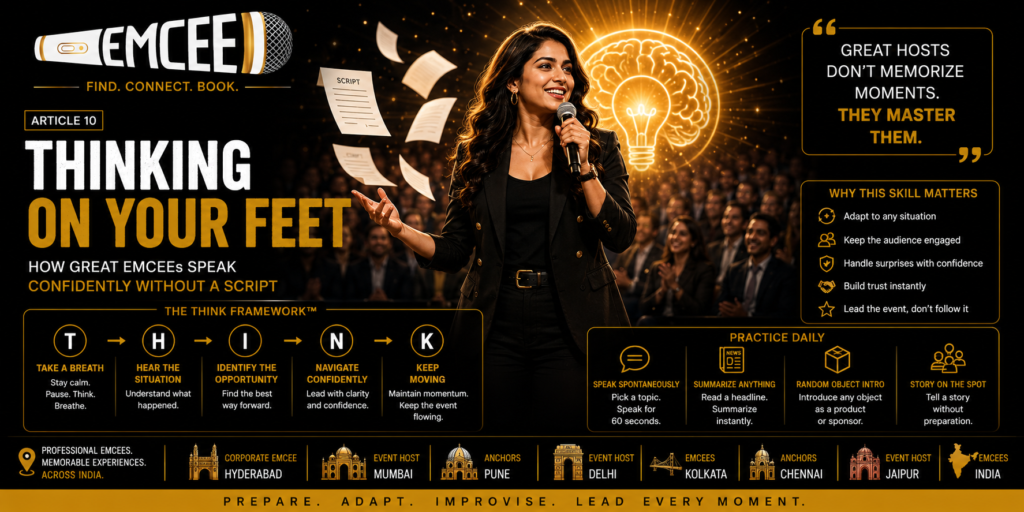
Learn how professional Corporate EMCEEs in Hyderabad, Event Hosts in Mumbai, Anchors in Pune, Event Hosts in Delhi, EMCEEs in Kolkata, Anchors in Chennai, and event professionals across India think on their feet, improvise confidently, and handle live situations without relying on scripts.
Introduction
Every emcee loves a well-prepared script.
Until reality happens.
A speaker arrives late.
A presentation crashes.
A VIP asks an unexpected question.
A sponsor wants a last-minute announcement.
Suddenly, the script is no longer enough.
This is where one of the most valuable skills in professional hosting comes into play:
Thinking on your feet.
Whether you’re a Corporate EMCEE in Hyderabad, an Event Host Mumbai professional, or an aspiring anchor preparing for your first stage appearance, your ability to adapt in real time can determine how audiences remember you.
What Does “Thinking on Your Feet” Really Mean?
Many people assume improvisation means speaking without preparation.
That’s incorrect.
Professional improvisation is the ability to respond effectively when reality differs from the plan.
It is:
- Staying calm under pressure
- Processing information quickly
- Making confident decisions
- Communicating clearly
The best hosts are not people who avoid surprises.
They are people who handle surprises well.
Why Event Managers Value This Skill
Event managers know something audiences don’t.
Every event contains uncertainty.
No matter how detailed the planning:
- Schedules change
- Speakers improvise
- Technology fails
- Audiences behave unpredictably
This is why experienced Event Hosts Delhi and Corporate EMCEEs Hyderabad are often selected over less experienced hosts.
Clients trust adaptability.
The Four Levels of Improvisation
At The EMCEE Academy™, we teach four levels of live-event thinking.
Level 1: Script Dependency
Characteristics:
- Relies entirely on prepared content
- Struggles with change
- Becomes nervous when plans shift
Most beginners start here.
Level 2: Script Flexibility
Characteristics:
- Can adjust wording
- Comfortable making minor changes
This is where many hosts remain.
Level 3: Situational Adaptability
Characteristics:
- Handles delays
- Responds confidently
- Maintains audience engagement
Professional hosts operate here.
Level 4: Event Leadership
Characteristics:
- Creates solutions instantly
- Protects event flow
- Influences audience emotions
This is where elite EMCEEs operate.
The THINK Framework™
When unexpected situations occur, use:
T – Take a Breath
Do not react emotionally.
Pause.
Think.
Breathe.
Professionalism begins with composure.
H – Hear the Situation
Understand:
- What happened?
- What information is accurate?
- What does the audience need?
I – Identify the Opportunity
Every challenge contains an opportunity.
Ask:
“How can I keep the audience engaged?”
N – Navigate Confidently
Lead with certainty.
Even if you don’t have every answer.
Confidence creates trust.
K – Keep Moving
Don’t get stuck on the problem.
Move the event forward.
Momentum matters.
Exercise #1: The 30-Second Challenge
Practice responding to random scenarios.
Example:
“The keynote speaker is delayed by 10 minutes.”
You have:
30 seconds.
Create a professional response.
Repeat daily.
This develops adaptability.
Why Great Hosts Ask Better Questions
When something unexpected happens, inexperienced hosts ask:
“Why is this happening?”
Professional hosts ask:
“What should happen next?”
One question creates frustration.
The other creates solutions.
Real-World Example
At a leadership summit, an Event Host Mumbai discovered moments before an award presentation that the winner’s name had changed.
There was no time to rewrite the script.
Instead of panicking, the host:
- Confirmed the updated information.
- Adjusted the introduction.
- Delivered the announcement confidently.
The audience never knew there had been a change.
That’s professional improvisation.
How to Improve Quick Thinking
Improvisation is not a talent.
It is a skill.
Practice These Daily
- Read news headlines and summarize them instantly.
- Introduce random household objects as if they were sponsors.
- Explain a familiar topic in 60 seconds.
- Tell a story without preparation.
These exercises strengthen mental flexibility.
Exercise #2: The Random Topic Drill
Write 20 random topics on slips of paper.
Examples:
- Coffee
- Cricket
- Leadership
- Hyderabad
- Weddings
Pick one.
Speak for 60 seconds.
No preparation.
The goal is not perfection.
The goal is flow.
Audience Engagement During Unscripted Moments
Many hosts fear silence.
Great hosts use interaction.
Examples:
Ask Questions
“How many of you have attended this event before?”
Invite Participation
“Let’s hear it for our amazing volunteers.”
Create Conversation
“What has been your biggest takeaway so far?”
Engagement buys time and maintains momentum.
Overcoming the Fear of Mistakes
Many aspiring hosts avoid improvisation because they’re afraid of getting it wrong.
Here’s the truth:
Audiences rarely expect perfection.
They expect confidence.
Most people forgive mistakes.
Few people forget panic.
The Confidence Loop
Confidence is not built by avoiding challenges.
Confidence is built by surviving challenges.
Every time you successfully navigate an unexpected situation:
- Confidence grows.
- Experience increases.
- Decision-making improves.
This is how professional Anchors in Pune and EMCEEs in Kolkata develop stage maturity.
Reflection
Think about the last time something unexpected happened on stage.
How did you respond?
What worked?
What would you change?
Growth begins with reflection.
Key Takeaways
- Thinking on your feet is a learnable skill.
- Great hosts adapt rather than panic.
- The THINK Framework™ improves decision-making.
- Improvisation comes from preparation and experience.
- Audience engagement helps during unexpected moments.
- Confidence grows through action, not avoidance.
FAQs
What does thinking on your feet mean for an emcee?
It means responding effectively to unexpected situations while maintaining professionalism and audience confidence.
Can improvisation be learned?
Yes. Like any communication skill, improvisation improves through practice and experience.
Why do Corporate EMCEEs in Hyderabad need improvisation skills?
Corporate events often involve last-minute changes, making adaptability a critical professional skill.
How can I improve quick thinking on stage?
Practice spontaneous speaking exercises, storytelling drills, and scenario-based training.
What is the biggest mistake hosts make during unexpected moments?
Panicking or focusing on the problem instead of guiding the audience forward.
Ready to Host with Confidence?
Looking for a Corporate EMCEE in Hyderabad, Event Host Mumbai, Anchors in Pune, Event Host Delhi, wedding EMCEE Kolkata, Anchors Chennai, Event Host Jaipur, or experienced EMCEEs anywhere in India?
Connect with EMCEE.in™ and access a trusted network of event professionals who know how to engage audiences, adapt under pressure, and create unforgettable experiences.
Because great hosts don’t just follow scripts. They create moments.