June 11, 2026
How To Become The Best Emcee In Your City: A Complete Step-By-Step Guide For Aspiring Professional Hosts In India
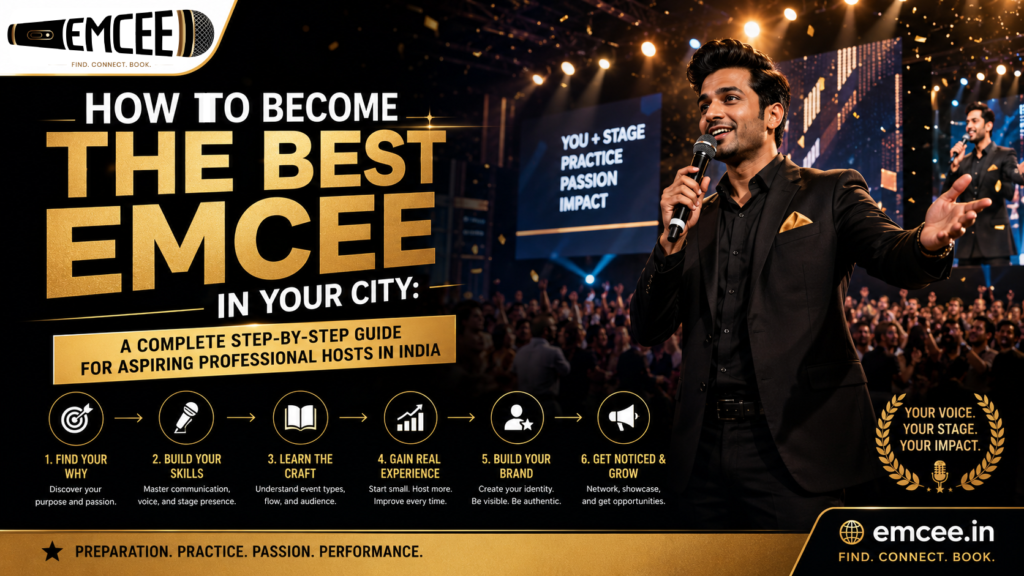
What This Guide Covers
This is not a motivational overview. This is a practical, no-fluff roadmap that answers the most common questions aspiring emcees in India search for:
- How do I start my career as a professional emcee?
- How do I get my first paid event?
- How do I build confidence on stage?
- How do I engage large audiences?
- How do I find clients without relying on agencies?
- How do I become the go-to emcee in my city?
If you follow this guide seriously, you will have a clearer picture of where you stand, what you are missing, and exactly what to do next.
Who Is A Professional Emcee?
A professional emcee — also called an anchor, event host, or compere — is the person responsible for managing the flow, energy, and experience of a live event.
An emcee is not just someone who speaks into a microphone.
A professional emcee is simultaneously:
- A storyteller who creates narrative arcs across the event
- A crowd psychologist who reads and shifts audience energy
- A crisis manager who handles delays, technical failures, and awkward silences
- A brand communicator who represents the client’s identity
- A entertainer who keeps the room engaged without stealing the show
- A logistics coordinator who ensures every segment transitions smoothly
India’s events industry is growing rapidly. From Tier 1 cities like Mumbai, Delhi, Bengaluru, and Hyderabad to Tier 2 cities like Pune, Jaipur, Coimbatore, and Indore — demand for skilled professional emcees has never been higher.
The question is: are you skilled enough to capture that demand in your city?
The Honest Reality Before You Begin
Before the step-by-step guide, here are truths most emcee resources won’t tell you:
Getting good takes longer than you think. Most professional emcees spend 2 to 4 years of consistent effort before earning reliable income from hosting alone.
Charm is not a career strategy. Many people enter this field because friends and family say they are “entertaining.” That is not sufficient. The industry rewards preparation, professionalism, and reliability — not just personality.
The competition in metro cities is real. Established emcees in Mumbai, Delhi, and Hyderabad have years of relationships, reels, and reputation. You cannot shortcut that. But you can out-niche them in your specific city or domain.
Most emcees undercharge and over-promise early on. This harms both their income and reputation. Pricing yourself correctly from the start matters.
Now, with that clarity in place — here is how to build a serious emcee career.
Step 1: Audit Your Current Communication Skills Honestly
Before investing in training, equipment, or branding — take an honest inventory of where you actually stand.
The Self-Audit Checklist
Record yourself speaking for 5 minutes on any topic and evaluate:
Voice Quality
- Is your voice clear and audible?
- Do you speak too fast or too slow?
- Does your tone stay flat or does it vary naturally?
- Are your words crisp or do you mumble?
Body Language
- Do you make eye contact with the camera or look away?
- Do your hands hang awkwardly or support your words?
- Do you fidget, sway, or touch your face repeatedly?
Language & Vocabulary
- Is your Hindi, English, or regional language command strong?
- Do you use filler words excessively — “um,” “like,” “basically,” “basically,” “so”?
- Can you articulate an idea in 3 different ways?
Presence
- Do you seem confident or apologetic?
- Is your energy engaging or draining to watch?
Most aspiring emcees who do this exercise discover they are significantly weaker than they assumed. That is not discouraging — it is useful. You now know what to fix.
Step 2: Build Your Foundation Skills (The Non-Negotiables)
2A. Voice Training
Your voice is your primary instrument. Neglecting it is like a musician ignoring their instrument.
What to practice:
- Breath control: Speak full sentences on a single exhale without rushing. Practice deep diaphragmatic breathing, not shallow chest breathing.
- Articulation drills: Practice tongue twisters daily. Classics like “She sells seashells” or Hindi variants like “Kaccha papad, pakka papad” train muscle memory in your mouth.
- Pacing: Record yourself, then deliberately slow down by 20%. Most nervous speakers talk too fast.
- Pitch variation: Monotone delivery kills audience attention. Practice raising your pitch on questions, lowering it for authority, and pausing dramatically before key moments.
- Projection: Learn to project from your diaphragm, not your throat. Your voice should carry without straining.
Suggested daily practice: 15 minutes of voice warm-ups and articulation drills before any public speaking or practice session.
2B. Script Writing and Memorization
Professional emcees are not just performers — they are writers.
The difference between a mediocre host and a great one is often visible in the quality of their transitions, introductions, and crowd lines.
How to write effective emcee scripts:
- Open with impact. Your first 30 seconds determines whether the audience trusts you. Do not open with “Good evening, ladies and gentlemen, it is my pleasure…” — every emcee says that. Open with a surprising fact, a story, a question, or an observation.
- Write transitions that are active, not passive. “And now, let’s welcome our next speaker” is weak. “The next voice you hear has spent 20 years building something most of us only dream about — please welcome…” is far more engaging.
- Personalize every script. Generic scripts are felt by audiences. Do your research on the client, the event, the speakers, and the audience before writing a single word.
- Write short. Then cut it further. Less is almost always better on stage.
Memorization approach: Do not memorize word-for-word unless absolutely necessary. Memorize the structure, key phrases, and transitions. Internalize the message, not the manuscript.
2C. Stage Presence and Physical Command
Stage presence is trainable. It is not a talent you either have or don’t.
Key physical habits to develop:
- Own your space. Stand with feet shoulder-width apart. Do not pace randomly — move with intention.
- Make deliberate eye contact. Scan the room in triangular patterns. Hold eye contact with individuals for 2 to 3 seconds before moving.
- Use your hands purposefully. Let gestures amplify your words, not distract from them.
- Control your stillness. The moments when you stop moving and hold the room in silence are often more powerful than everything you say.
The fastest way to build stage presence: Perform in front of real audiences as often as possible — even in small, low-stakes settings.
Step 3: Get Real Stage Experience (Even Without Paying Events)
This is where most aspiring emcees stall. They wait for a paying opportunity before building real skills. That is backwards.
Where To Get Free Stage Experience In Your City
College and University Events If you are a student, this is the highest-leverage opportunity available to you. College fests, departmental functions, farewell events, and cultural programs are run every week across India. Volunteer to host. Do it repeatedly. Fail in front of a forgiving audience before you fail in front of a paying client.
Corporate Internal Events Many companies host town halls, team lunches, onboarding sessions, and CSR events that need hosts. If you work in a company, offer to host internal events for free. This builds corporate hosting experience and a professional reference.
Community Events and NGO Functions Local clubs, RWAs (Resident Welfare Associations), religious and cultural organizations, and NGOs regularly run events. These are underserved markets where you can practice frequently.
Open Mic Nights and Toastmasters Toastmasters International has active chapters in most Indian cities. Joining one gives you structured feedback, regular speaking opportunities, and a community of serious communicators. This is one of the highest-ROI investments an aspiring emcee can make.
Charity Functions and Social Causes Hosting a fundraiser or charity event for free not only gives you experience — it gives you footage, goodwill, and network connections with event organizers who may recommend you for paid work.
The rule of thumb: Do not go for your first paid event until you have hosted at least 10 to 15 real events in front of real audiences. The pressure of getting paid before you are ready is the fastest path to a bad reputation.
Step 4: Identify Your Niche (Do Not Try To Host Everything)
The biggest strategic mistake new emcees make is positioning themselves as “available for all events.” That sounds like maximum opportunity — it is actually minimum effectiveness.
The emcees who dominate their cities are specialists, not generalists.
The Main Emcee Niches in India
Corporate Events Leadership summits, product launches, annual conferences, investor events, awards nights, and town halls. Requires business vocabulary, executive presence, and the ability to manage complex schedules.
Wedding Hosting One of the highest-demand and highest-paying niches in India. Wedding emcees manage sangeet nights, cocktail evenings, receptions, and multi-day functions. Requires high emotional intelligence, knowledge of family dynamics, and the ability to handle drunk uncles and crying aunties with grace.
Award Ceremonies GaLas, industry awards, and recognition nights. Requires gravitas, strong scripting, and the ability to sustain energy across a long program.
College Festivals High energy, youth audience, fast-paced. Requires spontaneity, humor, and the ability to handle chaos.
Lifestyle and Fashion Events Product launches, brand activations, pop-up events. Requires style, aesthetic awareness, and brand alignment.
Religious and Cultural Functions Specialized knowledge of customs, languages, and audience sensitivities is essential.
How To Choose Your Niche
Ask yourself:
- What kind of events do you genuinely enjoy attending?
- Where does your existing network open doors?
- What domain do you have knowledge or credibility in?
- What event type is in high demand in your city specifically?
Start by building depth in one niche before expanding to others. Being known as “Hyderabad’s best corporate emcee” is more valuable than being known as “someone who does all kinds of events.”
Step 5: Build Your Professional Portfolio
No portfolio means no bookings from serious clients. This is not optional.
What A Strong Emcee Portfolio Includes
Showreel (Video) The single most important asset in your portfolio. A showreel should be 90 to 120 seconds long and show you hosting actual events — not practice sessions in empty halls. It should demonstrate variety: different types of events, audience sizes, energy levels, and languages if applicable.
If you do not have event footage yet, here is what to do: Offer to host 3 to 5 events for free or at a heavily discounted rate on the explicit condition that the organizer allows you to bring a videographer. Invest in quality footage at this stage.
High-Quality Event Photos Professional photographs from real events. Not selfies. Not posed shots in a studio. Images of you commanding a real stage with a real audience.
Testimonials Written or video testimonials from event organizers, clients, or speakers. Even one strong testimonial from a recognized company or individual significantly increases your credibility.
A List of Events Hosted A simple, organized list of events you have hosted — company name or event name, type of event, city, and year. As you grow, this becomes a powerful trust signal.
Language and Format Capabilities Clearly state what languages you host in (Hindi, English, Telugu, Tamil, etc.) and what formats you are experienced with.
Step 6: Build Your Digital Presence and Personal Brand
In 2025 and beyond, your digital presence is your first impression with most potential clients. Many clients will Google your name or search for emcees on Instagram before making contact.
Platform-by-Platform Strategy
Instagram The most important platform for emcees in India right now. Post a mix of:
- Short clips from real events (Reels perform significantly better than static posts)
- Behind-the-scenes content showing your preparation process
- Educational content about event hosting (positions you as an authority)
- Testimonials and event highlights
Consistency matters more than perfection. Posting 3 times per week with average content beats posting once a month with perfect content.
LinkedIn Essential for corporate event bookings. Corporate HR managers, event managers, and marketing heads use LinkedIn to find and evaluate vendors. Your LinkedIn profile should clearly state your specialization, include a showreel link, list notable clients, and publish articles about event management and professional hosting.
Google (Your Own Website or Profile) You need a web presence that appears when someone searches your name or “professional emcee [your city].” At minimum, create a simple one-page website or a well-optimized profile on a verified platform like Emcee.in. Include your bio, showreel, event types, languages, and contact details.
YouTube Long-form content — hosting masterclasses, behind-the-scenes vlogs, event recaps — builds deeper authority and helps with Google search visibility over time.
Personal Branding Principles
- Pick a clear positioning statement. “Hyderabad’s go-to corporate emcee for leadership events” is stronger than “professional event host for all occasions.”
- Be consistent in visual identity. Use the same colors, font, and tone across all platforms.
- Show, don’t tell. Footage and testimonials are more convincing than any claim you make about yourself.
- Engage actively. Comment on event industry posts. Build relationships with event planners, AV companies, decorators, and photographers — they refer emcees constantly.
Step 7: Learn To Handle Every On-Stage Crisis
The difference between a good emcee and a great one becomes most visible when things go wrong — because things will go wrong.
Common On-Stage Crises and How To Handle Them
The speaker is late or missing. Do not announce the problem to the audience — that creates anxiety. Buy time with engagement. Ask the audience a question, share an interesting fact, invite a quick audience interaction, or reference something that happened earlier in the event. Stay calm. The audience takes their emotional cue from you.
The audio fails. Project your voice without the mic. If you have trained your voice, you can hold a room of 100 to 150 people without amplification for several minutes. Acknowledge it with a light touch of humor (“Well, let’s find out how far this voice actually carries”) and alert the technical team discreetly.
An awkward silence after a question or activity. Pause with intention. Do not rush to fill the silence. Say: “I’ll give you 10 more seconds on that — this is actually a great question to sit with.” Then move on naturally.
A speaker goes significantly overtime. This requires the emcee to balance respect for the speaker with the audience’s experience. Walk slowly towards the stage as a gentle visual cue. If the overrun continues, step in during a natural pause with a warm but firm transition: “That is such a powerful perspective — and I know we could all listen for another hour. Let’s thank [Name] and we’ll continue with…”
Audience energy crashes mid-event. This is your job to fix. Change your own energy level abruptly. Ask the audience to stand up and stretch. Introduce a quick, simple interactive segment. Speed up your own pacing. The room will follow your lead.
Technical failure with a video, presentation, or prop. Never freeze. Always have 2 minutes of engaging content ready to bridge any gap — a story, a trivia question, or a brief interactive activity. Professional emcees prepare for gaps the way pilots prepare for turbulence.
Step 8: Master Audience Engagement Techniques
Audience engagement is what separates forgettable hosts from ones who get referred endlessly.
Proven Audience Engagement Techniques
The Opening Hook Start every event with something unexpected. A surprising statistic, a bold question, a short story, or a moment of audience participation within the first 60 seconds. This tells the audience: “This person is worth paying attention to.”
Early Participation Get the audience to do something small within the first 5 minutes — raise their hand, respond to a question, or turn to the person next to them. Once people participate once, they are psychologically primed to participate again.
The Rule of Fives Re-engage the audience at least every 5 minutes. You cannot deliver 20 minutes of information and expect sustained attention. Break it up with interactions, transitions, humor, or changes in format.
Strategic Humor Humor is not about telling jokes. It is about finding the relatable, the absurd, or the unexpected in the room and naming it. The best event humor is observational — specific to this audience, this city, this event. Generic jokes fall flat. Specific observations land.
Callbacks Reference something that happened earlier in the event later in the program. This creates a sense of cohesion, makes the audience feel you are paying attention, and generates organic laughter and warmth.
Energy Matching and Leading Read the room. If the audience is tired after lunch, acknowledge it and adjust. Then gradually lift the energy rather than forcing high energy onto a low-energy room. You match first, then lead.
The Power of the Pause Silence is underrated. After an important moment, pause for 3 to 5 seconds and let it land. Do not rush to fill every gap. Audiences need space to process and feel.
Step 9: Price Yourself Correctly
Underpricing is one of the most common and damaging mistakes new emcees make.
How Emcee Pricing Works in India (2025 Reality)
Pricing varies significantly by city, event type, experience level, and demand. The ranges below are general approximations — not guaranteed rates.
Emerging Emcees (Under 2 Years Experience)
Corporate events: ₹5,000 to ₹15,000 per event in Hyderabad
Weddings: ₹8,000 to ₹20,000 per function in Hyderabad
College events: ₹3,000 to ₹10,000 in Hyderabad
Mid-Level Emcees (2–5 Years, Clear Niche, Good Reel)
Corporate events: ₹20,000 to ₹60,000 per event
Weddings: ₹25,000 to ₹75,000 per function
Large conferences or award nights: ₹40,000 to ₹1,00,000+
Established Emcees (5+ Years, Strong Brand, High Demand)
Hyderabad Corporate events: ₹75,000 to ₹2,50,000+
Hyderabad Premium weddings: ₹1,00,000 to ₹3,00,000+ per event
National corporate conferences: ₹2,00,000 to ₹5,00,000+
Pricing Principles
Do not reveal your rate immediately. Understand the event scope first — audience size, event duration, number of sessions, travel requirements, preparation time needed. Price for the total value delivered, not just the hours on stage.
Stop discounting to close deals. Discounting communicates insecurity, not generosity. If a client says your price is too high, ask what their budget is and decide whether the engagement makes sense at that level. Never justify your rate with apologies.
Charge for preparation, not just performance. A 4-hour event may require 10 hours of research, scripting, rehearsal, and coordination. Factor that into your pricing.
Raise your rates as your demand increases. When you are consistently booked, that is market feedback that your current rate is below what clients will pay.
Step 10: Build Your Client Network Systematically
Most emcee bookings in India come through referrals and relationships — not cold inquiries. Building the right network is a long-term competitive advantage.
Who To Build Relationships With
Event Management Companies The most direct referral source. Event planners hire emcees for most corporate and social events they manage. Introduce yourself professionally, share your portfolio, and stay in touch. Do not just send a WhatsApp message and disappear — follow up after 2 weeks, and keep the relationship warm.
Wedding Planners For emcees targeting the wedding market, wedding planners are gatekeepers. Get to know planners in your city, attend industry meetups, and make sure they have seen your footage. Mumbai Event Host
AV and Production Companies Audio-visual companies are on-site at every major event. They see emcees work in real conditions and often get asked by clients to recommend hosts. Build genuine relationships here.
Hotel Event Teams Hotels with large banquet halls host dozens of events every month. Their events teams often recommend emcees to clients. An introduction and a portfolio drop to the banquet manager of major hotels in your city is underutilized by most emcees.
Corporate HR and Admin Teams HR managers and executive assistants often directly book emcees for internal events. LinkedIn is your best channel to connect with these decision-makers.
Photographers and Videographers They are at every event. They see who does a good job. They get asked for recommendations constantly. Build mutual referral relationships.
The Follow-Up System
Most emcees make contact once and never follow up. That is where bookings are lost.
Build a simple contact management habit:
- After every event, email the client with a thank-you and a request for a testimonial
- Follow up with event planners who did not book you — circumstances change
- Check in with contacts every 60 to 90 days with something valuable (a reel, an article, a congratulatory note) — not just when you need work
Step 11: Keep Learning and Raising Your Standard
The emcees who remain relevant and in demand are the ones who treat this profession as a lifelong craft — not a skill they mastered once.
Continuous Development Practices
Watch the best in the world. Study how world-class emcees, TV show hosts, conference moderators, and TED Talk presenters command rooms. Analyze their technique, not just their charisma.
Record every event. Review your own footage critically. What worked? What fell flat? Where did energy drop? Where were you strongest? Most emcees stop reviewing their own work after the early years — that is when growth plateaus.
Get specific feedback. After events, ask a trusted observer (not just the client) what they noticed. Invite honest critique, not just validation. Hyderabad Event Host
Study adjacent disciplines. Improv comedy, acting, debate, journalism, stand-up comedy, behavioral psychology — these all sharpen emcee skills in ways that straightforward practice does not.
Attend events as an audience member. Study how audiences behave. What holds their attention? What loses it? What produces laughter or emotion? This field research is irreplaceable.
How To Become The Go-To Emcee In Your City: The Summary Strategy
If you want to dominate your local market, here is the compressed strategy:
Own a specific niche. Do not try to be everything to everyone. Be the best corporate emcee in Hyderabad, or the most trusted wedding host in Pune. Depth beats breadth in the early years.
Be more professional than your competition. Respond quickly. Show up prepared. Send event briefs before every engagement. Deliver a post-event thank-you. The basics of professionalism are ignored by most hosts — doing them consistently creates a real competitive advantage.
Generate visible proof constantly. Your showreel and social media presence should grow after every event. Clients in your city should be able to find you easily and immediately see evidence of your work.
Build real relationships. The event industry in any Indian city is smaller than it looks. Word of mouth travels fast — in both directions. Treat every gig, every vendor, and every client with the same professionalism regardless of the fee.
Play the long game. Your goal in Year 1 is not income — it is reputation and footage. Your goal in Year 2 is consistent bookings. Your goal in Year 3 is to be the name that comes up when event planners in your city think of your niche. That trajectory requires patience and consistent execution.
This step by step guide to become the Best Emcee In Your City by Aamer Siddiqui (Founder – EMCEE.in)
Frequently Asked Questions
Q: How do I become a professional emcee in India with no experience?
Start by building your communication skills, gaining stage experience at free events, creating video footage, and building your presence on LinkedIn and Instagram. Experience comes from doing — not waiting for the perfect opportunity.
Q: How much does a professional emcee charge in India?
Rates vary by city, niche, and experience. Emerging emcees typically charge ₹5,000 to ₹20,000 per event. Established professional emcees with strong reels and corporate clients earn ₹75,000 to ₹5,00,000+ per engagement.
Q: What is the difference between an emcee and an anchor in India?
The terms are used interchangeably in the Indian events industry. Both refer to the person who hosts and manages the flow of a live event.
Q: How do I handle stage fear as an emcee?
Stage fear does not disappear — it gets channeled. Focus on preparation, breath control, and performing in front of real audiences regularly. Each event builds your tolerance for pressure.
Q: Is emceeing a good career in India?
Yes — for people who invest seriously in the craft, build a strong personal brand, and develop a reliable client network. It is not a passive career. It requires active business development alongside performance skills.
Q: How do professional emcees find clients in India?
Through a combination of event management company relationships, digital presence, referrals from vendors (AV companies, photographers, wedding planners), LinkedIn outreach to corporate HR teams, and listings on platforms like Emcee.in.
Q: What languages should an emcee know in India?
At minimum, fluency in English and Hindi is essential for most markets. Regional language fluency (Telugu, Tamil, Kannada, Marathi, Bengali, etc.) gives you a significant advantage in city-specific and cultural event markets.
Q: How long does it take to become a successful professional emcee?
Most emcees who work consistently and strategically begin earning reliable income within 2 to 3 years. Building to premium rates and high demand typically takes 4 to 6 years of serious effort.
Final Thought: Preparation Is The Career
Every great emcee performance you have ever witnessed was built on hours of preparation the audience never saw.
The research done the night before. The script written and rewritten. The transitions practiced until they felt effortless. The contingency plans made for every scenario. The voice warm-up done in the hotel room before walking on stage.
What looks like natural talent on stage is almost always the result of obsessive preparation behind the scenes.
If you want to be the best emcee in your city, preparation is not your pre-work.
Preparation is your career.
Professional Emcee India, How To Become An Emcee, Best Emcee In Your City, Event Host Career India, Corporate Anchor India, Wedding Emcee India, Emcee Training India, Stage Confidence Tips, Audience Engagement Techniques, Female Emcee India
Event Hosting Tips India, Emcee Script Writing, How To Get Emcee Clients, Personal Branding For Emcees, Public Speaking India, Anchor Career 2025, Best Event Host Tips, Emcee Business Hyderabad India, Mumbai, Delhi, Kolkata, Pune, Chennai
Looking for a verified professional emcee for your next event? Explore trained, experienced event hosts, corporate anchors, wedding emcees, and live event professionals across India at Emcee.in.