June 24, 2026
The Art of Event Transitions: How Great Anchors Keep Events Flowing Seamlessly – The EMCEE Academy™ | Article 8
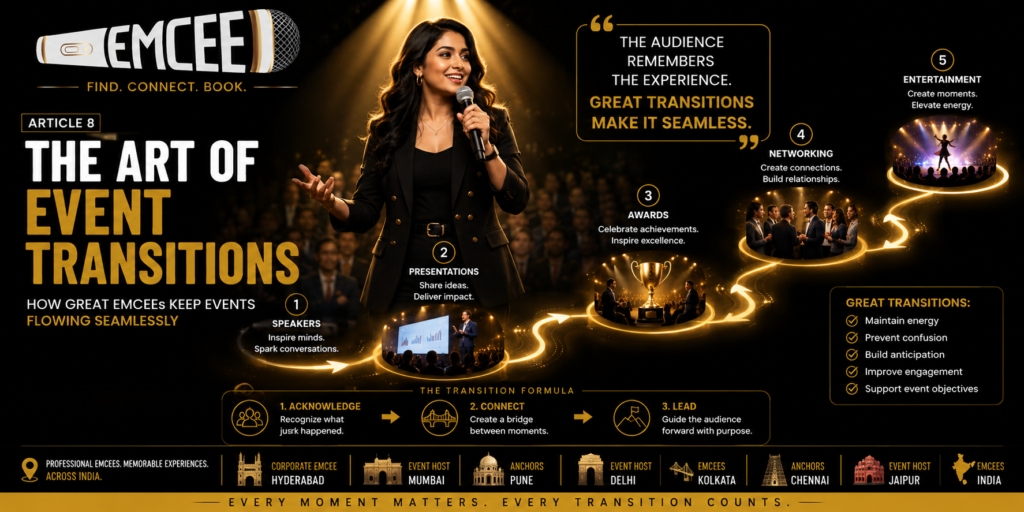
Learn how professional Corporate Anchors in Hyderabad, Event Hosts in Mumbai, Anchors in Pune, Event Hosts in Delhi, EMCEEs in Kolkata, Anchors in Chennai, and top hosts across India master event transitions to create seamless audience experiences and memorable events.
Introduction
Every successful event feels effortless.
The audience moves smoothly from one segment to another.
Speakers appear at the right moment.
Energy stays consistent.
Nothing feels awkward.
But behind every smooth event is an emcee who understands the art of transitions.
Transitions are the invisible bridges that connect an event.
Without them, even the most well-planned event can feel disjointed and confusing.
Whether you’re a Corporate EMCEE in Hyderabad, an Event Host Mumbai professional, or an aspiring host learning the craft, mastering transitions can instantly elevate your value.
What Is an Event Transition?
A transition is the connection between two moments.
Examples include:
- Moving from one speaker to another
- Introducing a performance
- Transitioning into an award ceremony
- Returning after a break
- Managing unexpected delays
Most new hosts focus on what happens during a segment.
Professional hosts focus on what happens between segments.
Why Transitions Matter
Think of an event as a movie.
Great scenes alone do not create a great film.
The scenes must connect naturally.
Events work the same way.
Strong transitions:
- Maintain energy
- Prevent confusion
- Build anticipation
- Improve audience engagement
- Support event objectives
Poor transitions create friction.
Great transitions create flow.
The Hidden Skill Event Managers Notice
Many event managers evaluate hosts differently than audiences.
Audiences notice:
- Humor
- Energy
- Personality
Event managers notice:
- Timing
- Professionalism
- Adaptability
- Event flow
A host who manages transitions effectively becomes an asset to the production team.
This is one reason experienced Event Hosts Delhi and Corporate EMCEEs Hyderabad receive repeat bookings.
The Four Types of Event Transitions
1. Informational Transitions
Purpose:
Move the audience from one agenda item to the next.
Example
“That was an inspiring session on leadership. Now let’s shift our focus to innovation and hear from our next speaker.”
Simple.
Clear.
Professional.
2. Emotional Transitions
Purpose:
Change the mood of the room.
Example
After a serious keynote:
“Thank you for those powerful insights. Let’s now celebrate some of the remarkable achievements within our organization.”
The energy shifts naturally.
3. Energy Transitions
Purpose:
Re-energize audiences.
Particularly important:
- Post-lunch
- Long conferences
- Multi-hour events
Professional EMCEEs often use audience interaction during these moments.
4. Recovery Transitions
Purpose:
Handle unexpected challenges.
Examples:
- Delayed speakers
- Technical issues
- Schedule changes
This is where great hosts truly shine.
The Transition Formula
At The EMCEE Academy™, we teach a simple framework.
Acknowledge → Connect → Lead
Step 1: Acknowledge
Recognize what just happened.
Step 2: Connect
Create a bridge.
Step 3: Lead
Guide the audience forward.
Example
“Thank you for that insightful discussion on business growth. As we continue exploring the future of innovation, I’d like to invite our next speaker to the stage.”
Simple.
Smooth.
Professional.
Exercise #1: The Bridge Builder
Create transitions between:
- A keynote and a panel discussion
- A performance and an award ceremony
- A networking break and a presentation
Practice building natural connections.
The more you practice, the more instinctive transitions become.
Common Transition Mistakes
Abrupt Changes
Example:
“Thank you. Next speaker.”
This creates a jarring experience.
Repetition
Using the same transition language repeatedly becomes predictable.
Overexplaining
Transitions should guide.
Not become speeches.
Ignoring Energy Levels
Great transitions consider audience mood.
Real-World Example
At a corporate conference in Hyderabad, a keynote speaker finished 20 minutes early.
The event schedule suddenly changed.
An inexperienced host might panic.
An experienced Corporate Anchor in Hyderabad adapted immediately.
They:
- Engaged the audience
- Shared a relevant story
- Conducted a quick interaction
- Maintained momentum
Most attendees never realized there had been a schedule issue.
That’s the power of transition mastery.
Transition Scripts Every EMCEE Should Know
Speaker to Speaker
“Building on that powerful insight, let’s continue the conversation with our next expert.”
Session to Break
“Take this opportunity to connect, recharge, and continue the discussion. We’ll resume shortly.”
Break to Session
“I hope everyone had a productive break. Let’s dive back into today’s agenda.”
Awards Segment
“It’s now time to recognize the individuals whose contributions have made a meaningful impact.”
Exercise #2: Record Your Transitions
Many hosts practice introductions.
Few practice transitions.
Record:
- A speaker introduction
- A break announcement
- An awards segment transition
Review:
- Clarity
- Energy
- Flow
- Confidence
Improvement begins with awareness.
The Psychology Behind Great Transitions
Audiences dislike uncertainty.
Transitions provide clarity.
When people know:
- What’s happening
- Why it matters
- What comes next
they feel more comfortable and engaged.
The best Event Hosts Mumbai understand that transitions reduce confusion and increase confidence.
Stage Fright and Transitions
Many hosts become nervous when events go off script.
Preparation reduces anxiety.
Before every event:
Prepare transition options for:
- Delays
- Early finishes
- Technical challenges
- Schedule changes
Preparation creates confidence.
Reflection
Think about the last event you attended.
Which moments felt awkward?
Which moments felt seamless?
Chances are the difference was transition quality.
Great events are often remembered because they feel effortless.
Key Takeaways
- Transitions connect event experiences.
- Great hosts focus on event flow.
- Strong transitions maintain audience engagement.
- Event managers highly value transition skills.
- Preparation improves adaptability.
- Seamless transitions create memorable events.
FAQs
What is an event transition?
An event transition is the process of moving audiences smoothly from one segment, speaker, or activity to another.
Why are transitions important for emcees?
Transitions maintain flow, reduce confusion, and keep audiences engaged throughout the event.
How do professional Corporate EMCEEs in Hyderabad handle delays?
They use prepared recovery transitions, audience engagement techniques, and flexible event management skills to maintain momentum.
What is the most common transition mistake?
Abrupt transitions that fail to connect one segment to the next.
Can transitions improve audience engagement?
Absolutely. Well-designed transitions help audiences stay focused and emotionally connected to the event.
Ready to Create Seamless Event Experiences?
Looking for a Corporate EMCEE in Hyderabad, Event Host Mumbai, Anchors in Pune, Event Host Delhi, EMCEE Kolkata, Anchors Chennai, Event Host Jaipur, or experienced EMCEEs anywhere in India?
Connect with EMCEE.in ™ and access professional hosts who understand audience psychology, event flow, and world-class event execution.
Because great events aren’t remembered for what happened. They’re remembered for how effortlessly everything came together.