June 17, 2026
The Microphone Myth: Why Holding a Mic Doesn’t Make You an Emcee – EMCEE.in Academy – Article 2
Why Holding a Microphone Doesn’t Make You an Emcee
Everyone Wants You On Their Stage™
EMCEE.in Academy – Article 2
Quick Answer
A microphone is a tool.
An emcee is a professional.
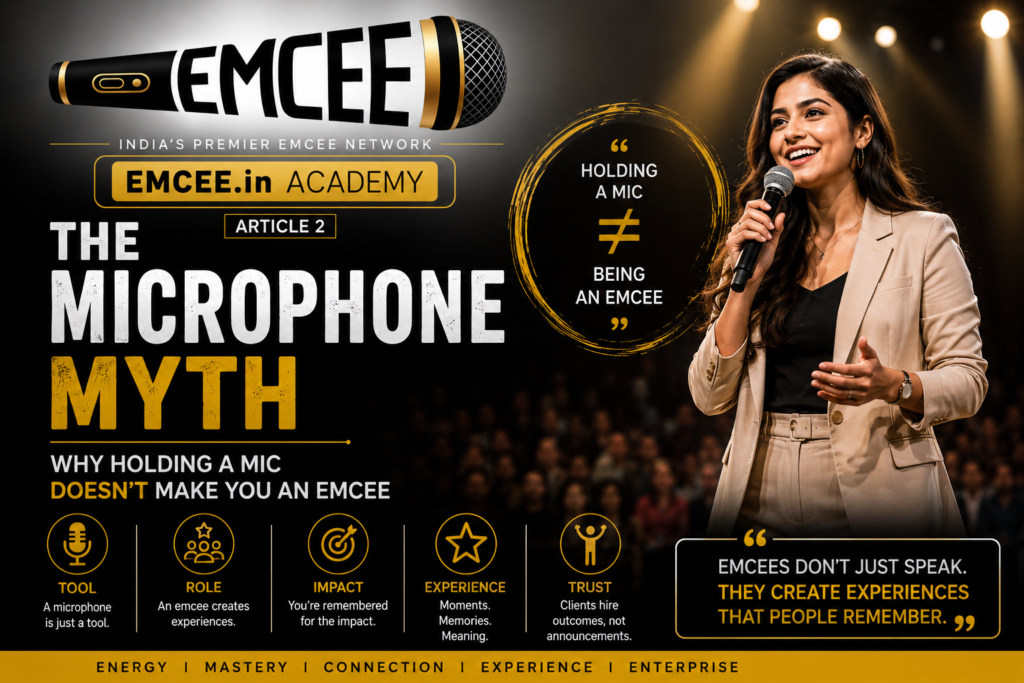
Owning a microphone doesn’t make someone an event host any more than owning a stethoscope makes someone a doctor.
The best emcees aren’t defined by what they hold in their hands.
They’re defined by what they create in the room.
The Most Expensive Mistake New Emcees Make
Every year, thousands of aspiring hosts enter the events industry.
Many believe the journey begins with:
- A wireless microphone
- A good voice
- A suit or stylish outfit
- A few event photos
- An Instagram page
And while those things help, they are not what clients pay for.
Clients don’t hire microphones.
They hire outcomes.
Yet many new hosts focus entirely on appearance rather than capability.
The result?
They look like emcees.
But they don’t perform like emcees.
The Difference Between Looking Professional and Being Professional
Imagine two people standing on stage.
Both are dressed well.
Both hold microphones.
Both speak English fluently.
Both have confident smiles.
To the audience, they appear identical.
But within ten minutes, the difference becomes obvious.
One controls the room.
The other merely occupies the stage.
One creates energy.
The other consumes it.
One guides the experience.
The other follows the schedule.
The microphone is the same.
The results are completely different.
The Invisible Skills Nobody Talks About
Most audiences notice:
- Voice
- Appearance
- Confidence
Clients notice something very different.
Professional event managers look for:
Preparation
Did the host understand the event?
Adaptability
Can they handle surprises?
Timing
Do they know when to speak and when to stay silent?
Leadership
Can they take control during uncertainty?
Audience Management
Can they maintain engagement?
These skills are invisible.
Yet they are often the reason someone gets booked again.
The Day The Script Failed
A script can never predict reality.
Imagine hosting an awards ceremony.
The script says:
“And now, please welcome our Chief Guest.”
The problem?
The Chief Guest is stuck in traffic.
Suddenly the schedule collapses.
The audience doesn’t care about your script.
The client doesn’t care about your script.
The event manager doesn’t care about your script.
What matters now is your ability to think.
To adapt.
To lead.
This is where professionals separate themselves from amateurs.
The Microphone Doesn’t Create Confidence
Many aspiring hosts believe confidence comes from experience.
Others believe confidence comes from talent.
Neither is entirely true.
Real confidence comes from preparation.
When you understand:
- The audience
- The event goals
- The flow
- The stakeholders
- The potential challenges
You stop fearing the stage.
Because you’re prepared for what might happen.
The microphone doesn’t create confidence.
Preparation does.
Why Event Managers Love Certain Emcees
Ask an event manager about their favorite host.
You’ll rarely hear:
“They had the best voice.”
Instead you’ll hear:
“They made my job easier.”
This is a powerful lesson.
The best emcees are problem solvers.
They:
- Arrive early
- Understand objectives
- Communicate clearly
- Support the production team
- Help speakers feel comfortable
- Handle unexpected situations gracefully
The microphone is simply one small part of that value.
The Three Levels of Hosting
Level 1: The Speaker
Focuses on talking.
Success depends on scripts.
Limited adaptability.
Level 2: The Presenter
Focuses on audience engagement.
Understands communication.
Creates better experiences.
Level 3: The Experience Creator
Focuses on outcomes.
Understands people.
Reads the room.
Leads energy.
Protects the event experience.
This is where elite emcees operate.
The Real Job Description of an Emcee
Most people think an emcee’s job is to speak.
A more accurate description would be:
“A professional responsible for guiding audience attention, managing event energy, supporting event objectives, and creating memorable experiences.”
Notice something?
Speaking is only one part of the sentence.
What Clients Are Actually Buying
When clients hire an emcee, they are buying:
Certainty
The confidence that the event is in capable hands.
Engagement
A host who can keep audiences connected.
Professionalism
Someone who represents the brand positively.
Energy
The ability to create momentum.
Peace of Mind
The knowledge that someone is managing the room.
These are the real products.
The microphone is simply the delivery mechanism.
The Future Belongs to Experience Creators
Artificial intelligence can write scripts.
Teleprompters can display words.
Technology can amplify voices.
But none of those things can replace human connection.
The future belongs to hosts who understand people.
Hosts who create moments.
Hosts who build trust.
Hosts who make audiences feel something.
Because at the end of every successful event, people rarely remember the microphone.
They remember the experience.
Final Thought
The microphone is the most visible part of an emcee’s job.
It’s also the least important.
A microphone can amplify your voice.
But it cannot amplify your professionalism.
It cannot amplify your preparation.
It cannot amplify your leadership.
Those things come from you.
And the day you stop focusing on the microphone and start focusing on the experience is the day you begin thinking like a true professional host.
Key Takeaways
- The microphone is a tool, not a profession.
- Clients hire outcomes, not announcements.
- Preparation creates confidence.
- Great emcees solve problems, not just read scripts.
- Experience creators outperform presenters.
- Professionalism is more valuable than performance.
Frequently Asked Questions
Can anyone become an emcee if they speak well?
No. Speaking well is important, but successful emcees also need event awareness, audience management skills, adaptability, and professionalism.
What is the biggest misconception about hosting?
The belief that speaking is the primary responsibility of an emcee. In reality, managing the audience experience is far more important.
Why do event managers repeatedly hire certain hosts?
Because they trust them to manage the event effectively, solve problems, and deliver a great audience experience.
What is the most important skill for an emcee?
The ability to create and sustain audience engagement while supporting the event’s objectives.