June 7, 2026
Best anchoring script for Yoga Day — with live asana commentary
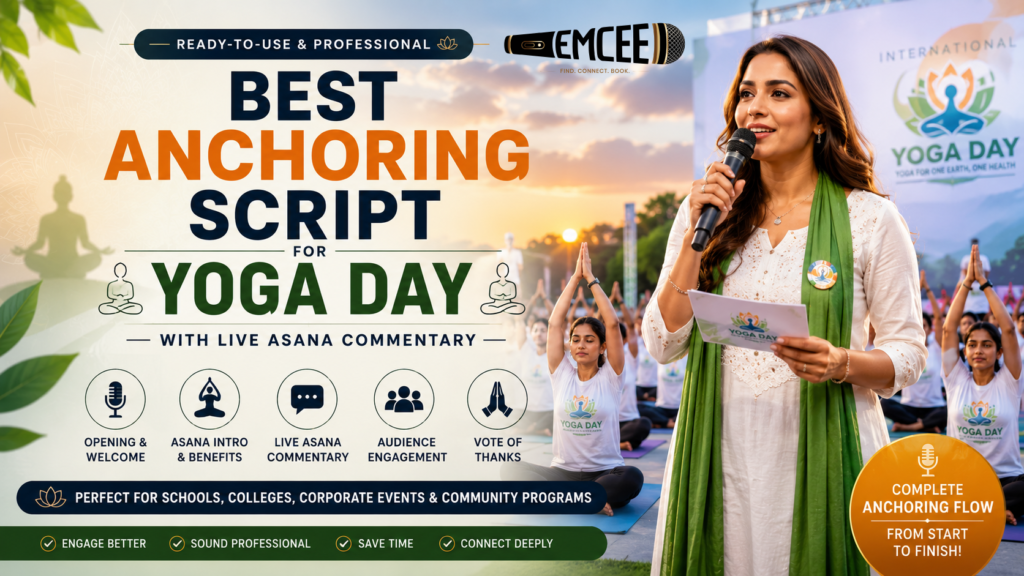
International Yoga Day falls on 21 June every year. School and college events on this day are unlike any other assembly — they require a calm, measured voice, correct Sanskrit pronunciation, and the specific skill of providing live commentary while students are on their mats performing postures. This page provides a complete, ready-to-use anchoring script for Yoga Day 2026, structured in four phases: the spiritual opening, an overview of yoga, live asana commentary, and a closing sankalp (pledge). Use it as written or adapt it to your event’s specific programme.
On this page
- Phase 1 — Spiritual opening with shloka
- Phase 2 — Importance of yoga
- Phase 3 — Live asana commentary
- Phase 4 — Sankalp and closing
- Asana pronunciation reference
- Anchor cheat sheet
- Frequently asked questions
Phase 1 — Spiritual opening
The shloka and welcome address
Anchor 1
Om Sahana Vavatu, Sahanau Bhunaktu, Sahaveeryam Karavavahai, Tejasvi Navadhitamastu, Ma Vidvishavahai. Om Shanti Shanti Shanti.
Anchor 2 — translation
May the divine protect us both — teacher and student. May we be nourished together. May we work with great energy. May our learning be vigorous and effective. May we never harbour resentment toward each other. Let there be peace — in thought, in word, and in action.
Anchor 1
A very peaceful and energetic morning to our respected Principal, our dedicated teachers, and every student gathered here today. On this 21st of June, we do not merely celebrate as a school — we join the entire world in observing the International Day of Yoga.
Phase 2 — The importance of yoga
Keep this section brief — the focus of Yoga Day is practice, not speeches
Anchor 2
In today’s world, where screens occupy more of our attention than sunlight, and where our minds rarely get a moment of true rest, the ancient science of yoga offers something no technology can: stillness. Yoga originated in India thousands of years ago, and it has never been more relevant than it is right now.
Anchor 1
The word yoga comes from the Sanskrit root “yuj” — meaning union. Union of body with breath, and breath with mind. To formally inaugurate today’s session and share their insight on this living tradition, we humbly invite our respected Principal to address the gathering.
After the principal’s address
Anchor 2
Thank you, Sir / Ma’am, for those guiding words. Now we move from words to practice. I request everyone to please take their position on their yoga mats. Sit comfortably, with your spine straight and your eyes gently closed.
Phase 3 — Live asana commentary
Speak slowly, with pauses. Your words must match the pace of movement on the ground
Anchor 1 — opening breathwork
We begin with the breath. Close your eyes. Keep your spine gently upright. Take a slow, deep breath in through your nose… and release it softly through your mouth. With every exhale, let go of the morning’s noise. Let go of any tension. We are here. We are present.
Anchor 2 — Tadasana
Our first posture is Tadasana — the Mountain Pose. Please observe the instructor on stage. Slowly rise to a standing position. Feel your feet planted firmly on the ground. Raise your arms, interlace your fingers above your head, and lift your heels gently. Tadasana improves posture, builds balance, and brings clarity to a restless mind.
Anchor 1 — Vrikshasana
We move now to Vrikshasana — the Tree Pose. Fix your gaze on a single, still point in front of you. Slowly shift your weight onto one foot and draw the other foot to rest against your inner calf or thigh. This posture asks you to find stillness in an unsteady position — just as we must remain grounded when life becomes uncertain.
Anchor 2 — Anulom Vilom Pranayama
Please return to your seated position for our breathing practice. We will now perform Anulom Vilom — Alternate Nostril Breathing. Using your right hand, gently close your right nostril with your thumb. Inhale slowly through your left nostril. Now close the left with your ring finger, and exhale through the right. This pranayama purifies the respiratory system and quiets a restless mind. Continue for five cycles at your own pace.
Phase 4 — Sankalp and closing
The pledge, a closing reflection, and the national anthem
Anchor 1
As we gently open our eyes and bring our awareness back to this space, take a moment to sit quietly. Place your hands on your knees. Feel the stillness you have earned. Now, join your hands at your heart, and let us take a sankalp — a pledge — together.
“I commit to remain in a balanced state of mind at all times. I commit to fulfil my duty toward myself, my family, my community, and the world around me. I pledge to make yoga not just a practice for today, but a discipline for life.”
Anchor 1
Yoga is not about how far you can stretch. It is about how deeply you can listen — to your body, your breath, and your own silence. Let today be the beginning of that listening, not just on the 21st of June, but every morning.
Anchor 2
This brings us to the conclusion of our International Yoga Day celebration. I request everyone to please rise for our national anthem.
Asana pronunciation reference
Practice these before the event — mispronunciation on the mic damages credibility
Asana / term |
Pronunciation guide |
Meaning |
|---|---|---|
| Tadasana | taa-DAAH-sun-aa | Mountain Pose — tada means mountain |
| Vrikshasana | vrik-SHAAH-sun-aa | Tree Pose — vriksha means tree |
| Bhujangasana | boo-jung-GAAH-sun-aa | Cobra Pose — bhujanga means serpent |
| Pranayama | prah-naa-YAAH-maa | Breath control — prana means life force |
| Anulom Vilom | uh-noo-LOM vi-LOM | Alternate nostril breathing |
| Sankalp | SUN-kulp | Vow or pledge made with intention |
| Shavasana | shaav-VAAH-sun-aa | Corpse Pose — used for final relaxation |
Anchor cheat sheet
Key principles for hosting a Yoga Day event
Adopt the radio voice
Think late-night FM: deep, unhurried, soothing. If you speak at your normal event pace, you will break the meditative atmosphere. Slow down by 30% and add pauses between sentences.
Practise Sanskrit terms
Say each asana name ten times aloud the night before. Use the pronunciation guide above. Confident Sanskrit pronunciation is one of the clearest marks of a prepared anchor on Yoga Day.
Watch the crowd, not the paper
During live commentary, keep your eyes on the students and instructor. If people are still settling into a pose when you are already at the next line, pause. Your script serves the session — not the other way around.
Keep speeches short
Yoga Day is about movement, not oratory. Phase 2 should take no more than five minutes including the principal’s address. Audiences come to practise, not to listen to an extended speech about yoga’s history.
Match tone to moment
Yoga Day is not a high-energy event like a sports day or cultural programme. Enthusiasm here means warmth and quiet confidence — not loudness. The crowd will mirror your energy, so set the right one from the first sentence.
Coordinate the run-of-show
Confirm with the yoga instructor which asanas are in the official protocol before the event. Your commentary must match what is actually being demonstrated — do not improvise asana descriptions without knowing the sequence.
Frequently asked questions
Which International Yoga Day is it in 2026?
21 June 2026 marks the 12th International Day of Yoga. The United Nations declared June 21 as International Yoga Day in 2014, with the first official observance held on 21 June 2015.
What is the theme for International Yoga Day 2026?
The official theme for each year is announced by the United Nations and the Ministry of Ayush. Check the Ministry of Ayush website (ayush.gov.in) closer to June 2026 for the confirmed theme and incorporate it into Phase 2 of your script.
Can a single anchor host Yoga Day, or is a two-anchor format required?
A single anchor can manage the entire script by combining both parts sequentially. The two-anchor format is preferred for larger events because it creates natural vocal variety, which helps maintain the meditative tone across a longer session. If anchoring solo, take a visible pause between the two “voices” to separate transitions.
What is the correct way to pronounce Vrikshasana?
Vrikshasana is pronounced vrik-SHAAH-sun-aa. The emphasis falls on the second syllable. Vriksha (tree) + asana (posture). Practise the full word slowly five to ten times before the event. See the pronunciation reference table above for other commonly used terms.
What shloka is typically used to open a Yoga Day event?
The most commonly used opening shloka for Yoga Day in schools is the Sahana Vavatu — a shanti path from the Taittiriya Upanishad that invokes peace between teacher and student. The full text and its meaning are included in Phase 1 of this script. Some schools also use the Gayatri Mantra or a simple Om chant as the opening.
Do I need to be a yoga practitioner to anchor a Yoga Day event?
No. Your role as anchor is to guide the event, not to demonstrate postures. However, you should understand the names, basic descriptions, and benefits of the asanas in the programme, and be able to pronounce them correctly. Attend one rehearsal with the yoga instructor before the event to align your commentary with the actual sequence.