May 16, 2026
Pritee Kathpal – “I Don’t Just Host the Show, I Own How It Feels”
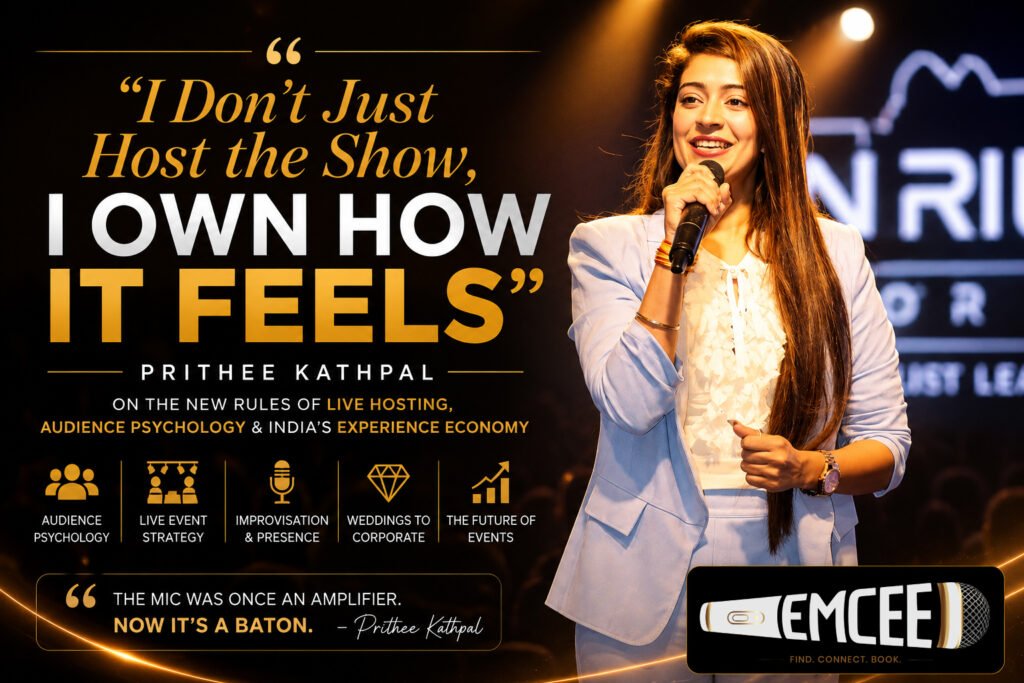
Pritee Kathpal on the New Rules of Live Hosting, Audience Psychology & India’s Experience Economy
In India’s rapidly evolving live events industry, the role of the emcee has transformed dramatically. Today’s hosts are no longer limited to reading scripts and introducing speakers — they are energy architects, cultural translators, crowd psychologists and, increasingly, the emotional backbone of the event itself.
From luxury weddings and corporate summits to immersive brand experiences and large-scale entertainment productions, modern live hosting demands far more than stage presence. It requires instinct, adaptability, digital fluency and the ability to command both the ballroom and the algorithm.
Few understand this shift better than Prithee Kathpal.
Known for her sharp wit, commanding stage presence and ability to seamlessly move between boardroom sophistication and high-energy live entertainment, Kathpal represents a new generation of Indian emcees redefining what it means to host in the era of experience-first events.
In this conversation, she speaks about shrinking attention spans, audience psychology, the chaos behind luxury weddings, the future of branded events and why today’s emcees are no longer just anchors — but custodians of how an event feels.

Q: As live events become increasingly experience-led, how has the role of an emcee evolved from being a stage anchor to becoming a core part of audience engagement strategy?
Pritee Kathpal:
We’ve honestly metamorphosed from compères to curators of catharsis.
Earlier, my job was simple: walk on stage, introduce the CEO, thank the sponsors, move to the next segment. Today? I have to introduce the CEO and ensure the room stays alive long enough to absorb what he’s saying without everyone mentally checking out after slide three.
The modern emcee is no longer outside the strategy — we are part of it.
I’m now included in:
- Brand conversations
- Experience mapping
- Audience flow discussions
- Engagement strategy meetings
And most importantly, I’ve become the emotional thermostat of the room.
I’m constantly reading:
- Body language
- Energy shifts
- Attention fatigue
- Audience responsiveness
Sometimes I extend a moment because the room needs it. Sometimes I cut a segment instantly because the energy is collapsing.
That’s the shift.
Experience-led events come with accountability.
I don’t just host the show anymore, I own how it feels.
Q: From corporate summits to luxury weddings and experiential events, what are organisers expecting from emcees today that they weren’t a few years ago?
Pritee Kathpal:
The mandate has shifted from elocution to exegesis.
A few years ago the brief was:
“Please stick to the script.”
Today the brief is:
“Understand the brand, ditch the script, hold the room, and make the event trend on LinkedIn before lunch.”
Organisers now expect:
- Strategic understanding
- Intellectual agility
- Cultural fluency
- Digital presence
- Real-time improvisation
One moment I’m hosting a Global Capability Centre launch in Hyderabad and a few hours later I’m managing a luxury wedding in Udaipur.
The challenge is:
Be adaptable without ever looking artificial.
The modern emcee has to feel:
- Sophisticated
- Relevant
- Spontaneous
- Human
And audiences detect fake energy instantly.
Q: Audience engagement can make or break an event. What are the biggest mistakes organisers still make?
Pritee Kathpal:
The biggest mistake?
Perfunctory participation.
You cannot throw a QR-code poll after three hours of PowerPoint and call it audience engagement.
That’s like serving dessert after everyone has already left the restaurant.
Another major issue is poor opening energy.
The first few minutes determine everything:
- Trust
- Attention
- Emotional investment
And yet many events still begin mechanically.
The third mistake is assuming all audiences behave the same way.
A bridal party and a BFSI leadership summit do not respond to the same humour, pacing or interaction style.
People often remember very little of what you said.
But they never forget how you made them feel.
And honestly?
Engagement dies in the back rows first.
If you haven’t thought about what the 14th row is experiencing, you haven’t designed a live event — you’ve designed a broadcast.
Q: Attention spans are shrinking rapidly. How has that changed live hosting?
Pritee Kathpal:
The era of the endless keynote is deservedly over.
Reel culture has fundamentally altered audience psychology.
If a speaker takes 40 minutes to make one point:
- The audience is gone
- Half the room is on Instagram
- The rest are replying to emails
So now I prepare differently.
I build:
- Narrative modules
- Short emotional hooks
- Faster transitions
- Extempore recovery moments
I also do what I call:
“Energy accounting.”
I map events almost psychologically:
- Where is the audience fatigue point?
- Where does the dopamine spike happen?
- Where should the room breathe?
- When do we interrupt cognitive overload?
A good emcee today isn’t just reading a script.
They are managing collective human attention in real time.
And honestly, the old:
“Come on guys, make some noise!”
…is passé now.
Audiences want authentic interaction, not forced hype.
Q: In highly produced experiential events, how critical is the emcee’s role in maintaining flow when things go wrong?
Pritee Kathpal:
I’m basically the human failsafe between technical chaos and audience perception.
LED wall freezes?
I become the LED wall.
Teleprompter dies?
I become the teleprompter.
Mic cuts out?
I suddenly discover spiritual resilience.
The audience should never feel panic.
That’s the real job.
Because seamlessness isn’t about perfection.
It’s about concealing imperfection gracefully.
And in India, we deal with a very specific kind of unpredictability:
- Monsoon humidity
- Audio failures
- Last-minute timeline collapses
- Generator issues
- Delayed entries
- Sudden VIP changes
The international playbook doesn’t prepare you for Indian event chaos.
The emcee’s calm becomes the room’s calm.
Q: Corporate events today feel more immersive and interactive than ever before. How has that changed hosting itself?
Pritee Kathpal:
We’ve moved from oratory to orchestration.
The podium is retired.
Now it’s:
- One handheld mic
- Two earpieces
- Zero permission to be boring
Corporate hosting today is no longer about maintaining decorum.
It’s about:
- Making conversations human
- Making brands relatable
- Making audiences participate
I’m no longer “talking to” the audience.
I’m co-hosting with them.
Some of the best panels I’ve moderated recently became powerful because the audience contributed almost half the insight.
My role was curation — not domination.
Q: Luxury weddings today look like full-scale productions. How has hosting evolved inside this space?
Pritee Kathpal:
Luxury weddings today are essentially live Bollywood productions with real emotions and no retakes.
I need:
- The family dynamics
- The inside jokes
- Emotional sensitivities
- Timeline flexibility
- Diplomatic immunity in case I accidentally roast the wrong uncle
And chaos?
Chaos is inevitable.
Most weddings run late.
So sometimes I’m silently rewriting:
- The sangeet structure
- Family entries
- Segment flow
- Emotional pacing
…inside my head while smiling at 400 guests.
But here’s the truth:
The emcee becomes the only stabilising force once chaos arrives.
And everyone listens to the person holding the mic.
That responsibility is enormous.
Q: For branded experiential events, how important is it for emcees to deeply understand brand messaging?
Pritee Kathpal:
Ignoring brand messaging today makes an emcee completely irrelevant.
Clients don’t hire us just to sound polished.
They hire us to:
- Carry the narrative
- Protect brand tone
- Reinforce positioning
- Translate messaging emotionally
If a legacy bank wants trust, every transition I make must support trust.
If an EV brand wants innovation, my pacing, references and energy must reflect innovation.
I now ask every client:
“What is the one sentence you want people to remember after this event?”
That answer shapes everything.
Because if I’m off-message,
I’m off-brand.
Simple.
Q: What trends do you think will redefine India’s live hosting industry over the next few years?
Pritee Kathpal:
We’re entering a fascinating era.
Today I’m no longer hosting only for the ballroom.
I’m also hosting for:
- Livestream viewers
- Instagram clips
- LinkedIn audiences
- Reels
- Digital replay culture
So the emcee now exists simultaneously:
🎤 On stage
📱 On social media
🌍 Inside brand strategy
I also believe we’ll see:
- Data-informed hosting
- Hyper-personalised engagement
- Multi-language fluidity
- Wellness-driven event pacing
- Cognitive reset moments
Attention today is expensive.
People don’t want constant stimulation anymore.
They want intentional experiences.
And in India especially, the modern emcee must be able to switch effortlessly from:
- Boardroom English
to - Gen-Z Hindi
within the same sentence.
That flexibility will define the future.
Q: Final thoughts?
Pritee Kathpal:
The microphone used to be an amplifier.
Today, it’s a baton.
And in India — where people applaud with their hearts but scroll with their thumbs — you have to conduct the room like a symphony, not a school assembly.
At the end of the day, my philosophy is simple: